Publication Summary
Long-term emollient therapy improves xerosis in children with atopic dermatitis
Objective
Assess the efficacy and tolerability of long-term emollient therapy in the treatment of moderate to severe xerosis in young children with atopic dermatitis (AD).
Study
Phase III, multicentre, double-blind, randomized, vehicle-controlled trial.
Population
251 children aged 2 to 6 years with AD-associated xerosis and a SCORAD index < 15.9, randomly assigned into two groups (1:1).
Dosage
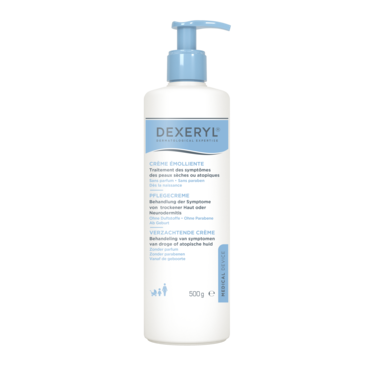
28-day treatment with twice-daily application of Dexeryl Cream as an emollient or its vehicle.
Non-responders at the end of the double-blind period were treated open-label with the emollient until day 84.
Responders stopped treatment until reassessment on day 56.
Those who relapsed after stopping treatment were then treated open-label with the emollient until day 84.
Duration
84 days.
Primary Outcome Measure
Xerosis score (XS), which corresponds to the dryness severity assessment in the SCORAD (Scoring Atopic Dermatitis) index, a validated assessment tool for AD (0 = absent; 1 = mild; 2 = moderate; 3 = severe).
A treatment response was defined as a decrease in XS score from 3 or 2 at baseline to 1 or 0.
Secondary Outcome Measures
Objective SCORAD index
Xerosis assessment using a visual analogue scale (X-VAS) (linear 100 mm scale where 0 = "No dry skin at all" and 100 = "Extremely dry skin")
Pruritus assessment using a visual analogue scale (P-VAS)
Hydration index (HI)
Results
During the double-blind period, the xerosis score (XS), objective SCORAD, and visual analogue scale scores decreased, while skin hydration increased more significantly in the emollient group than in the vehicle group (P < 0.001 for all measures).
More patients were responders with the emollient than with the vehicle (66.1% vs. 45.6%, P < 0.001).
During the open-label period, stopping emollient treatment led to relapse, but improvement returned when treatment was restarted.
Regular use of the emollient also led to improvement in children who had not initially responded to treatment.
Tolerability
Adverse events were similar in both groups, and no treatment-related serious adverse events were reported.
Conclusion
Long-term emollient therapy is effective and well tolerated for the treatment of xerosis in children with atopic dermatitis.
Our other publications on this subject
Want to read on?
This access is reserved for professionals, registered on Pierre Fabre For Med.
To access the full content, please register or log in if you already have an account.